• singing
  • mindfulness
  • blog
    • who I help
    • my story
    • credentials
  • contact

Catherine Kay Brown

  • singing
  • mindfulness
  • blog
  • about
    • who I help
    • my story
    • credentials
  • contact

The Hidden Reason Voice Use Hurts

One of the hardest voice disorder symptoms to treat is chronic pain. Some voice disorder patients experience constant throat pain. Others feel it every time they speak or after times of overuse. For some, it is their only symptom. It can present as a dull ache, stabbing or sharp pain, or a constant sore throat. Others experience tension that borders on pain. Many are given diagnoses of Muscle Tension Dysphonia or Laryngeal Hypersensitivity (also known as Irritable Larynx Syndrome). Voice therapy may or may not make a difference.

I recently learned about a mindfulness-based modality, Pain Reprocessing Therapy (PRT), that may help. The National Association of Teachers of Singing (NATS) just hosted a panel titled, “Integrating Pain Reprocessing Therapy Into Multidisciplinary Voice Care.” You can read my summary below. 

In my next my 8-week mindfulness course for people with voice disorders, I plan to include specific insights and exercises from PRT to help participants with chronic pain and muscle tension. 

ENROLLMENT IS OPEN NOW

WHAT IS PAIN REPROCESSING THERAPY? 
PRT is a mindfulness-based modality designed to help people overcome neuroplastic pain. Neuroplastic pain is pain that is not caused by tissue damage or a structural issue in the body. It is an unconsciously learned pattern of pain that is based in fear or similar emotions. 

Neuroplastic pain often has the following characteristics:

  • originated during a stressful time

  • originated without injury or lasted past the time in which the injury should have healed

  • symptoms are inconsistent and worsen with stress

  • symptom triggers are unrelated to the body (may be tied to specific activities, places, or stressors)

  • pain has a delayed onset (begins some time after an injury)

  • patient experienced childhood stress or adversity

  • patient displays certain personality traits (perfectionism, people-pleasing, high conscientiousness, high self-criticism)

  • lack of physical diagnosis or a diagnosis that doesn’t account for symptom severity

Neuroplastic pain is real pain. The brain generates all pain whether or not there’s tissue damage involved. Understanding the neuroplastic component simply opens up new treatment options.


PRIMARY VS. SECONDARY PAIN

It’s useful to distinguish between two types of pain: primary pain, where neuroplastic pain is the only issue, and secondary pain, where a structural problem exists as a root cause but neuroplastic processes layer on top, creating “mixed” pain. (It’s worth noting that many vocal fold “abnormalities” appear in pain-free populations.) PRT is most effective against primary neuroplastic pain, but it can reduce the severity of secondary pain as well.

THE PAIN-FEAR CYCLE

The central mechanism PRT targets is the pain-fear cycle: pain generates fear, which causes the brain to misinterpret safe signals as dangerous, producing more pain, which generates more fear. Avoidance behaviors — such as speaking or singing less — may reinforce these danger signals rather than resolving them.

WHAT DOES PAIN REPROCESSING THERAPY INVOLVE?

PRT follows five stages and participants see results in as few as 8 weeks.

  1. Assess for neuroplastic pain using the indicators listed above.

  2. Educate the patient about how pain develops and persists, and the importance of breaking the pain-fear cycle.

  3. Gather and reinforce evidence that the patient’s condition is neuroplastic. This psychoeducation is essential for buy-in and creating a sense of safety.

  4. Pain safety learning through exposure and reappraisal. This means helping patients reappraise sensations as safe, leaning into positive sensations and joy, and getting back to doing what they love.

  5. Address other fears, threatening emotions, and stress to calm the nervous system overall. (Mindfulness is an excellent tool for calming the nervous system.)

THE 8-WEEK MINDFULNESS COURSE. One of the central practices in PRT is a mindfulness-based exercise called Somatic Tracking. I have always incorporated similar exercises into my 8-week mindfulness course for people with voice disorders. However, in the next course, I plan to include specific insights and exercises from PRT to help participants overcome chronic pain and muscle tension. The next class begins on April 12, 2026. Participation is limited. Sign up today. 

8-WEEK MINDFULNESS COURSE
DROP-IN MINDFULNESS CLASSES
MINDFULENSS RECORDINGS

Posted in meditation, mindfulness, mindfulness meditation, online course, speaking voice, vocal health, voice disorders and tagged with mindfulness meditation, mindful voice, mindfulness, voice disorders.

March 18, 2026 by Catherine K. Brown.
  • March 18, 2026
  • Catherine K. Brown
  • mindfulness meditation
  • mindful voice
  • mindfulness
  • voice disorders
  • meditation
  • mindfulness
  • mindfulness meditation
  • online course
  • speaking voice
  • vocal health
  • voice disorders
  • Post a comment
Comment

Book Recommendation: The Lost Voice by Greta Morgan

Have you ever read a book that described your own experience so completely that you finally felt seen and understood? For me, Greta Morgan's memoir The Lost Voice is that book (Amazon affiliate link). 

My story isn't exactly like Greta's. She was a successful songwriter-singer touring with a rock band when Covid triggered what would eventually be diagnosed as spasmodic dysphonia (also known as laryngeal dystonia). I was a high school student and aspiring classical singer when the flu weakened my vocal cords and decimated my high range. (You can read more of my story here.)

Still, similarities abound. Years of vocal struggles before finally receiving a diagnosis. Undergoing vocal rehabilitation. (We both worked with the wonderful Lori Sonnenberg, who specializes in rehabilitating singers with vocal injuries.) Turning to mindfulness. Pivoting to a different career path.  

Most people with a voice disorder don't know anyone with similar struggles. If this is true for you, Greta's memoir will hold a mirror to your own experience. 

So much of what Greta describes in her book reflects the themes that both I and my mindfulness students with voice disorders have lived:

  • the disorienting sense that your voice has betrayed you

  • a frenzied search for answers, both medical ("What's wrong and can it be fixed?") and metaphysical ("Why me?")

  • an overwhelming sense of loss

  • grieving the old voice

  • struggling with identity and sense of self ("Am I still myself without my voice?")

  • confronting social isolation

  • turning to mindfulness

  • settling into acceptance

  • finding new purpose in living with a voice disorder

Greta's book is a poignant tale of human struggle: first, a constant striving for career success, and then a gradual acceptance of the vulnerability that a voice disorder brings. Her prose is powerfully descriptive and deeply emotional. She is a talented songwriter, after all — and she finds beauty and humanity everywhere.

One of the best parts of my mindfulness work is connecting people with voice disorders with each other while also modeling mindfulness skills that can help them cope with their condition. Greta's gorgeous memoir accomplishes a similar task in story form. And I think it's a must-read for anyone with a voice disorder. 

I love watching my mindfulness students listen to each other's voices. People who are shy about speaking up in work meetings feel comfortable talking to others who sound like them. And this brings me to my favorite thing about Greta's book: in the audio version, she reads the introduction and acknowledgements herself! As someone who loves seeing people embrace a beautifully broken voice, this touched me deeply.

Posted in voice disorders, recommended, resources and tagged with voice disorders, books.

August 24, 2025 by Catherine K. Brown.
  • August 24, 2025
  • Catherine K. Brown
  • voice disorders
  • books
  • voice disorders
  • recommended
  • resources
  • Post a comment
Comment

Mindfulness Myths: Knowing What Mindfulness Is — and Isn't — Can Help You Stick with It

When I teach mindfulness meditation, I find that many people have tried it before and felt it “didn't work” for them. Often the feeling that mindfulness failed them — or that they failed at mindfulness — is based on common misconceptions.

Posted in meditation, mindfulness, mindfulness meditation, voice disorders and tagged with mindfulness, mindfulness meditation, mindful voice, voice disorders.

June 19, 2025 by Catherine K. Brown.
  • June 19, 2025
  • Catherine K. Brown
  • mindfulness
  • mindfulness meditation
  • mindful voice
  • voice disorders
  • meditation
  • mindfulness
  • mindfulness meditation
  • voice disorders
  • Post a comment
Comment

My Story: A Singer with Voice Disorders

Read more about my journey as a singer with voice disorders and how mindfulness helped me overcome muscle tension dysphonia. I now offer mindfulness classes for others with voice disorders. The curriculum is based on my own published, peer-reviewed research.

Posted in body work, meditation, mindfulness, mindfulness meditation, online course, speaking voice, vocal health, voice disorders and tagged with voice teacher, voice disorders, mindfulness meditation, mindfulness, mindful voice.

September 13, 2024 by Catherine K. Brown.
  • September 13, 2024
  • Catherine K. Brown
  • voice teacher
  • voice disorders
  • mindfulness meditation
  • mindfulness
  • mindful voice
  • body work
  • meditation
  • mindfulness
  • mindfulness meditation
  • online course
  • speaking voice
  • vocal health
  • voice disorders
  • Post a comment
Comment

How Mindfulness May Help People with Voice Disorders

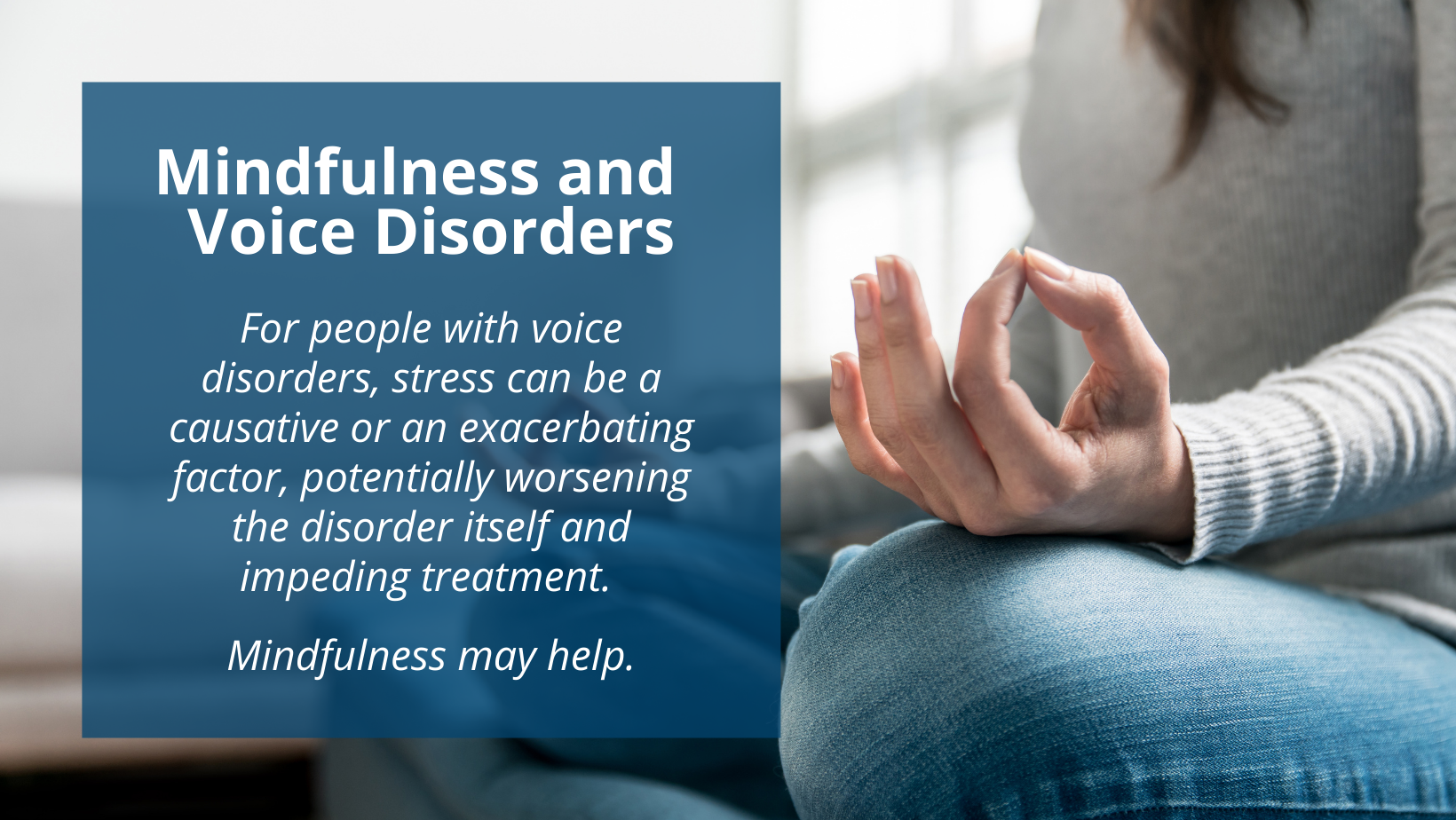
For people with voice disorders, stress can be a causative or an exacerbating factor, potentially worsening the disorder itself and impeding treatment. People with voice disorders often experience high stress levels; social and emotional isolation; and loss, including the loss of work opportunities, sense of self, and the ability to communicate. Mindfulness meditation may help.

Posted in meditation, mindfulness, mindfulness meditation, speaking voice, vocal health and tagged with mindfulness, meditation, mindfulness meditation, voice disorders, vocal health, stress, stress reduction, stress management.

April 24, 2024 by Catherine K. Brown.
  • April 24, 2024
  • Catherine K. Brown
  • mindfulness
  • meditation
  • mindfulness meditation
  • voice disorders
  • vocal health
  • stress
  • stress reduction
  • stress management
  • meditation
  • mindfulness
  • mindfulness meditation
  • speaking voice
  • vocal health
  • Post a comment
Comment

How to Find a Voice Specialist Speech-Language Pathologist

Most speech-language pathologists (SLPs) have very little experience and training in treating voice disorders. As part of their masters degree, SLPs are required to take one course in voice disorders — and that course may focus more on signs and symptoms than on treatment. If you’ve been diagnosed with a voice disorder, it is essential that you see an SLP who is well-versed in voice. But how can you know whether an SLPs has the experience to help you? This post will give you some ideas of what to look for or what questions to ask.

Posted in speaking voice, vocal health, voice disorders and tagged with vocal health, voice disorders, speaking voice.

February 11, 2023 by Catherine K. Brown.
  • February 11, 2023
  • Catherine K. Brown
  • vocal health
  • voice disorders
  • speaking voice
  • speaking voice
  • vocal health
  • voice disorders
  • 1 Comment
1 Comment
How to Find a Voice Doctor

How to Find a Voice Doctor

Most doctors (even ENTs) don’t have the experience it takes to treat singers or anyone with a complex voice disorder. If you’re shopping for a voice-savvy ENT, look for an otolaryngologist who has completed a fellowship in Laryngology and the Care of the Professional Voice. There are just over 20 such fellowship programs in the United States. I recommend looking for a large hospital with a voice center that employs laryngologists and speech-language pathologists who specialize in voice. This blog post includes an extensive list. However, many regions of the country do not have a voice clinic, and you would be well-served by finding any fellowship-trained laryngologist. I recommend visiting the website of the American Laryngological Association, where you can search for members by location. The search feature does not function perfectly, but it provides a place to start.

Posted in vocal health, speaking voice and tagged with vocal health, voice disorders.

February 11, 2023 by Catherine K. Brown.
  • February 11, 2023
  • Catherine K. Brown
  • vocal health
  • voice disorders
  • vocal health
  • speaking voice
  • 1 Comment
1 Comment
Mindfulness for People with Voice Disorders

Study: Mindfulness for People with Voice Disorders

Nearly every modern textbook on vocal pedagogy, vocal health, or the causes and treatment of voice disorders recommends stress reduction as both a preventive and therapeutic tool for voice users and patients with voice disorders. We know from extensive research in various populations that Mindfulness Based Interventions (MBIs) can reduce stress. Yet I have been unable to find any studies on the effects of mindfulness in people with voice disorders. I decided to run my own.

Posted in meditation, mindfulness, mindfulness meditation, speaking voice, vocal health and tagged with mindfulness, mindfulness meditation, vocal health, voice disorders.

January 27, 2022 by Catherine K. Brown.
  • January 27, 2022
  • Catherine K. Brown
  • mindfulness
  • mindfulness meditation
  • vocal health
  • voice disorders
  • meditation
  • mindfulness
  • mindfulness meditation
  • speaking voice
  • vocal health
  • 4 Comments
4 Comments

Catherine Kay Brown

voice and mindfulness teacher, Downingtown, Chester County, PA

Catherine K. Brown is a voice teacher, performer and blogger based in Downingtown (Chester County), PA. She teaches private singing lessons and group classes from her home studio.

  • singing
  • mindfulness
  • blog
    • who I help
    • my story
    • credentials
  • contact

Studio Portal


All Current Students:
login to view, schedule, or cancel lessons, or to pay your invoice

Potential Students (Singing): register for more info about voice lessons

Potential Students (Mindfulness): learn more about mindfulness offerings


1.png
2.png
3.png
4.png
5.png

Powered by Squarespace.