
• singing
  • mindfulness
  • blog
    • who I help
    • my story
    • credentials
  • contact

Catherine Kay Brown

  • singing
  • mindfulness
  • blog
  • about
    • who I help
    • my story
    • credentials
  • contact

The Hidden Reason Voice Use Can Hurt

One of the hardest voice disorder symptoms to treat is chronic pain. Some voice disorder patients experience constant throat pain. Others feel it every time they speak or after times of overuse. For some, it is their only symptom. It can present as a dull ache, stabbing or sharp pain, or a constant sore throat. Others experience tension that borders on pain. Many are given diagnoses of Muscle Tension Dysphonia or Laryngeal Hypersensitivity (also known as Irritable Larynx Syndrome). Voice therapy may or may not make a difference.

I recently learned about a mindfulness-based modality, Pain Reprocessing Therapy (PRT), that may help. The National Association of Teachers of Singing (NATS) just hosted a panel titled, “Integrating Pain Reprocessing Therapy Into Multidisciplinary Voice Care.” You can read my summary below. 

In my next my 8-week mindfulness course for people with voice disorders, I plan to include specific insights and exercises from PRT to help participants with chronic pain and muscle tension. 

ENROLLMENT IS OPEN NOW

WHAT IS PAIN REPROCESSING THERAPY? 
PRT is a mindfulness-based modality designed to help people overcome neuroplastic pain. Neuroplastic pain is pain that is not caused by tissue damage or a structural issue in the body. It is an unconsciously learned pattern of pain that is based in fear or similar emotions. 

Neuroplastic pain often has the following characteristics:

  • originated during a stressful time

  • originated without injury or lasted past the time in which the injury should have healed

  • symptoms are inconsistent and worsen with stress

  • symptom triggers are unrelated to the body (may be tied to specific activities, places, or stressors)

  • pain has a delayed onset (begins some time after an injury)

  • patient experienced childhood stress or adversity

  • patient displays certain personality traits (perfectionism, people-pleasing, high conscientiousness, high self-criticism)

  • lack of physical diagnosis or a diagnosis that doesn’t account for symptom severity

Neuroplastic pain is real pain. The brain generates all pain whether or not there’s tissue damage involved. Understanding the neuroplastic component simply opens up new treatment options.


PRIMARY VS. SECONDARY PAIN

It’s useful to distinguish between two types of pain: primary pain, where neuroplastic pain is the only issue, and secondary pain, where a structural problem exists as a root cause but neuroplastic processes layer on top, creating “mixed” pain. (It’s worth noting that many vocal fold “abnormalities” appear in pain-free populations.) PRT is most effective against primary neuroplastic pain, but it can reduce the severity of secondary pain as well.

THE PAIN-FEAR CYCLE

The central mechanism PRT targets is the pain-fear cycle: pain generates fear, which causes the brain to misinterpret safe signals as dangerous, producing more pain, which generates more fear. Avoidance behaviors — such as speaking or singing less — may reinforce these danger signals rather than resolving them.

WHAT DOES PAIN REPROCESSING THERAPY INVOLVE?

PRT follows five stages and participants see results in as few as 8 weeks.

  1. Assess for neuroplastic pain using the indicators listed above.

  2. Educate the patient about how pain develops and persists, and the importance of breaking the pain-fear cycle.

  3. Gather and reinforce evidence that the patient’s condition is neuroplastic. This psychoeducation is essential for buy-in and creating a sense of safety.

  4. Pain safety learning through exposure and reappraisal. This means helping patients reappraise sensations as safe, leaning into positive sensations and joy, and getting back to doing what they love.

  5. Address other fears, threatening emotions, and stress to calm the nervous system overall. (Mindfulness is an excellent tool for calming the nervous system.)

THE 8-WEEK MINDFULNESS COURSE. One of the central practices in PRT is a mindfulness-based exercise called Somatic Tracking. I have always incorporated similar exercises into my 8-week mindfulness course for people with voice disorders. However, in the next course, I plan to include specific insights and exercises from PRT to help participants overcome chronic pain and muscle tension. The next class begins on April 12, 2026. Participation is limited. Sign up today. 
8-WEEK MINDFULNESS COURSE
DROP-IN MINDFULNESS CLASSES
MINDFULENSS RECORDINGS

Posted in meditation, mindfulness, mindfulness meditation, online course, speaking voice, vocal health, voice disorders and tagged with mindfulness meditation, mindful voice, mindfulness, voice disorders.

March 18, 2026 by Catherine K. Brown.
  • March 18, 2026
  • Catherine K. Brown
  • mindfulness meditation
  • mindful voice
  • mindfulness
  • voice disorders
  • meditation
  • mindfulness
  • mindfulness meditation
  • online course
  • speaking voice
  • vocal health
  • voice disorders
  • Post a comment
Comment

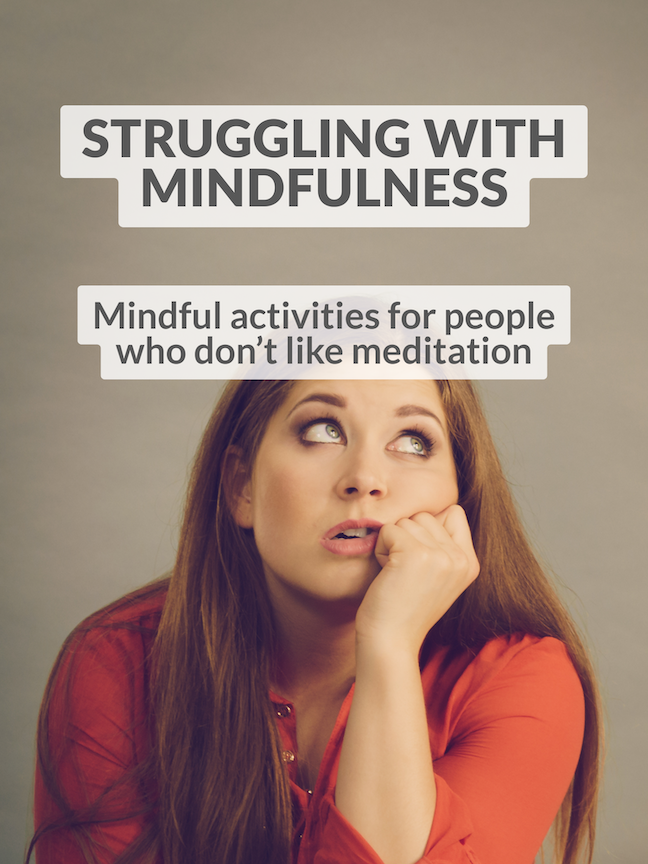
Struggling with Mindfulness: Mindful Activities for People Who Don't Like Meditation

Let’s say you’ve tried a few meditations or taken a mindfulness class, but nothing clicked. Maybe you felt like you were doing it all wrong, or there was a feeling you expected that never came. Instead of mindfulness being relaxing, it became an exercise in frustration and failure. 

You are not alone. A lot of people have misconceptions about mindfulness that involve unrealistic expectations. (For example, “mindfulness means clearing your mind of thoughts.” Um, that’s not going to happen — and that’s okay.) 

Mindfulness can be particularly difficult for certain people (neurodivergent brains, trauma survivors, people with mental health challenges). Some of us just need different ways in. 

Below is a list of mindfulness practices you can try if traditional meditation has been a struggle. 

  • Engage your senses: sight, sound, smell, taste, and touch. Engage sight by setting aside time to look at artwork, a colorful object, or a beautiful view. Try listening to a video of ocean sounds. Use essential oils to engage your sense of smell. Do the raisin exercise for taste. Enjoy the touch of a soft pillow, blanket, or pet.

  • Deprive your senses. If sensory experiences overwhelm you, try depriving your senses of input. Lie still in a dark room and simply notice your breathing or your body. Wear comfortable clothing. Cover your eyes with a sleep mask. Use noise-canceling headphones to block distracting sounds. Some people even enjoy using a sensory deprivation float tank.

  • Try mindful movement. Some of us just can’t sit still, but that doesn’t mean we can’t benefit from mindfulness. Yoga, tai chi, and qigong are all forms of mindful movement. You can also try a walking meditation.

  • Turn everyday activities into mindful experiences. Explore mindful eating or mindful walking. Practice the STOP technique.

  • Do calming, single-focus activities like gardening, needlework, crafting, puzzles, or coloring (Amazon affiliate link). Notice your breathing and your body as you engage in your chosen activity.

  • Engage your mind by learning about mindfulness. If you enjoy books (printed, electronic, audio) or podcasts, there are numerous options. My favorite mindfulness book is Jon Kabat Zinn’s Wherever You Go There You Are (Amazon affiliate link). Favorite podcasts include Tara Brach’s podcast, Sharon Salzberg’s Metta Hour, Gil Fronsdal’s AudioDharma, and On Being with Krista Tippett.

  • Take a mindfulness class. Over and over, my mindfulness students tell me that my 8-week mindfulness course for people with voice disorders has changed their perspective on what mindfulness is — and has helped them practice it in a way that is accessible to them. The class begins on September 21, 2025.

Posted in meditation, mindfulness, mindfulness meditation, online course, speaking voice, vocal health, voice disorders and tagged with mindfulness meditation, mindful voice, mindfulness, meditation.

August 19, 2025 by Catherine K. Brown.
  • August 19, 2025
  • Catherine K. Brown
  • mindfulness meditation
  • mindful voice
  • mindfulness
  • meditation
  • meditation
  • mindfulness
  • mindfulness meditation
  • online course
  • speaking voice
  • vocal health
  • voice disorders
  • Post a comment
Comment

My Story: A Singer with Voice Disorders

Read more about my journey as a singer with voice disorders and how mindfulness helped me overcome muscle tension dysphonia. I now offer mindfulness classes for others with voice disorders. The curriculum is based on my own published, peer-reviewed research.

Posted in body work, meditation, mindfulness, mindfulness meditation, online course, speaking voice, vocal health, voice disorders and tagged with voice teacher, voice disorders, mindfulness meditation, mindfulness, mindful voice.

September 13, 2024 by Catherine K. Brown.
  • September 13, 2024
  • Catherine K. Brown
  • voice teacher
  • voice disorders
  • mindfulness meditation
  • mindfulness
  • mindful voice
  • body work
  • meditation
  • mindfulness
  • mindfulness meditation
  • online course
  • speaking voice
  • vocal health
  • voice disorders
  • Post a comment
Comment
Horizontal image of women meditating in a group overlaid with text: Benefits of Group Mindfulness for People with Voice Disorders: Practicing mindfulness in a group produces better outcomes than solo practice.

Benefits of Group Mindfulness for People with Voice Disorders

Did you know that practicing mindfulness in a group has been shown to produce better outcomes than practicing alone? The popular press frequently touts the health benefits of mindfulness, but rarely states that those benefits are almost always gained in group settings. If you've been practicing mindfulness on your own using recordings or an app, consider joining a class instead.

Posted in meditation, mindfulness, mindfulness meditation, online course, vocal health and tagged with mindfulness, vocal health.

June 1, 2022 by Catherine K. Brown.
  • June 1, 2022
  • Catherine K. Brown
  • mindfulness
  • vocal health
  • meditation
  • mindfulness
  • mindfulness meditation
  • online course
  • vocal health
  • 2 Comments
2 Comments

Catherine Kay Brown

voice and mindfulness teacher, Downingtown, Chester County, PA

Catherine K. Brown is a voice teacher, performer and blogger based in Downingtown (Chester County), PA. She teaches private singing lessons and group classes from her home studio.

  • singing
  • mindfulness
  • blog
    • who I help
    • my story
    • credentials
  • contact

Studio Portal


All Current Students:
login to view, schedule, or cancel lessons, or to pay your invoice

Potential Students (Singing): register for more info about voice lessons

Potential Students (Mindfulness): learn more about mindfulness offerings


1.png
2.png
3.png
4.png
5.png

Powered by Squarespace.